Most museum visitors expect to learn about history by reading plaques or looking at artifacts behind glass. A team of iLEAD Academy students hopes to offer a much more immersive experience.
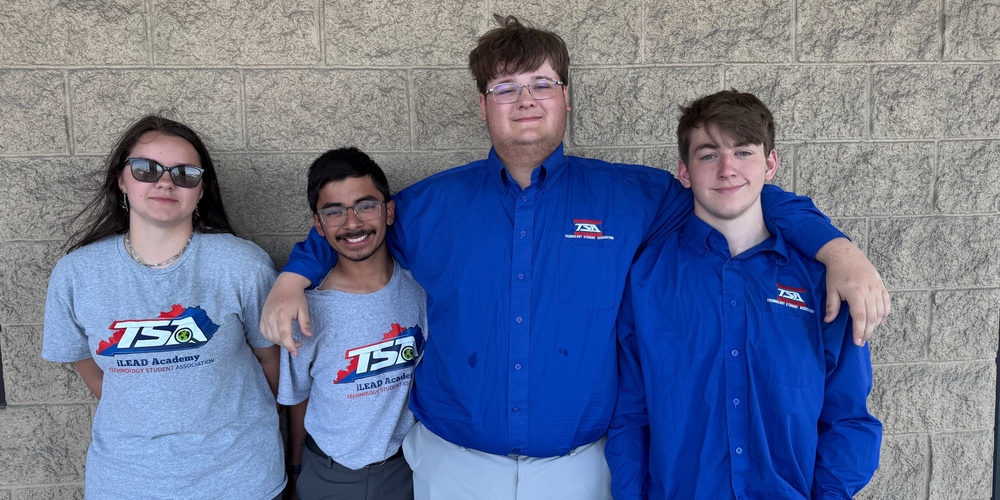
Ava Ritchie, Cody Lawson, Elias Cardoso-Ortiz and Logan Clifton will represent Carroll County at the Technology Student Association National Conference after earning a spot with their virtual reality project, an interactive museum that transports visitors to ancient Rome.
The project challenged students to create a virtual museum centered on a historical time period while incorporating elements of history, art and technology. The team chose ancient Rome because they believed it would stand out from more common topics.
"We chose Rome because we felt like it wouldn't be one many teams would do," Elias said.
Their finished product features a grand museum with four rooms. Visitors enter through a large main hall before exploring exhibits focused on Roman history, art and technology. Interactive displays allow users to select exhibits and learn more about the information being presented.
The project was the result of months of collaboration and countless hours of work spread across the entire school year.
"It was a lot of labor by different people," Elias said.
Each student played a unique role in bringing the museum to life. Elias served as the primary programmer and 3D modeler, creating interactive features and building much of the virtual environment. Ava focused on the artistic elements, designing original artwork inspired by the Roman era.
"I looked at some of the art from the actual time and knew I wanted to go in that direction," Ava said. "I made six different drawings."
She began each piece with hand sketches before digitally enhancing them with color and texture. The finished works were then incorporated into the museum's exhibits.
While creating the museum was challenging, making it function smoothly inside a virtual reality headset proved even more difficult.
Cody spent much of his time optimizing the experience to ensure the headset could process the museum without sacrificing quality.
"We had all these really complex pieces that the headset didn't really like," Cody said. "We had to make everything smoother. It was enough where it ran well and still looked really nice."
Logan focused on lighting and visual effects, carefully adjusting how exhibits were illuminated to create a realistic museum atmosphere. Several lighting designs had to be reworked to balance appearance and performance.
"There was an issue with a type of light that wouldn't exactly do what I wanted," Logan said. "I figured out it was because of a certain setting we hadn't enabled."
One of the most difficult aspects of the project involved designing interactive displays that would work for users of different heights and movement styles.
"The hardest thing was opening information in a 3D space," Elias said. "Everybody moves differently, so you had to make sure it was versatile."
The team's efforts paid off at the state competition, where judges praised both the quality of the project and the students' presentation. Now they are preparing for nationals, where they expect significantly more competition and tougher judging.
Despite the challenge ahead, the students are optimistic and hoping to place in the top three.